
We have been talking about the cost of living in Bermuda as though it is purely a financial matter — a problem for economists, for policymakers, for budget committees. But I need to say this plainly, and I need you to really hear it: what we are describing is a health crisis. A human crisis. And it is unfolding quietly, steadily, in the bodies of the very people this community depends on.
I don’t arrive at this conclusion from data alone. I arrive at it from people. Real people, sitting across from me, telling me their real lives. Good people. Hardworking, determined, deeply committed people who are doing absolutely everything they were told to do — and finding that it is still not enough. That gap between effort and outcome? That gap is where health goes to die.
So let me tell you what this actually looks like, because it deserves to be said out loud.
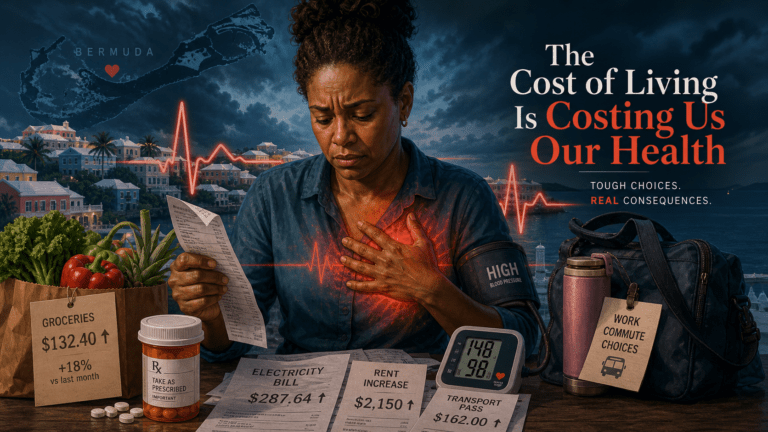
It looks like someone standing in a pharmacy, doing quiet math in their head, deciding whether this month they eat well or medicate well — because they cannot afford to do both. It looks like a mother spooning less onto her own plate so her children don’t notice there isn’t quite enough. It looks like a man running on fumes between his first job and his second, unable to catch his breath — not metaphorically, but literally — because his body has been running on stress and sacrifice for so long it has simply started to break down. It looks like a kind of exhaustion that no amount of sleep can touch, because the worry never stops long enough to let real rest in.
This is what financial pressure does to a human body. And we need to stop pretending otherwise.
Because one of healthcare’s greatest failures is this: we have reduced health to diet and exercise, while ignoring the forces that determine whether those choices are even possible. We tell people to eat better in a country where healthy food costs more than most families can reasonably absorb. We tell people to exercise in a country where working two jobs leaves no time to move. We tell people to manage their stress in a country where the cost of simply existing is itself the source of that stress. Health is not just what you eat or how often you move.
It is your lived experience. It is your relationships. It is your environment.
And yes — it is your financial reality. In one of the most expensive places in the world to live, that reality is crushing people. Quietly. Daily. In ways that don’t show up until they show up as a diagnosis.
The science is not ambiguous on this. When a person lives under relentless economic stress — when every single day begins with the weight of rent, groceries, bills, and the quiet arithmetic of not enough — that stress does not remain a feeling. It becomes physiology. It floods the body with cortisol. It raises blood pressure. It disrupts sleep. It drives inflammation. It destabilizes blood sugar. And over time, quietly, invisibly, it lays the foundation for the diagnoses we then act shocked to see. We should not be shocked. We are seeing alarming rates of elevated blood pressure across our population, and a significant portion of our community continues to face real barriers to accessing quality healthcare — often the very people most at risk of these conditions. We have the data. We have had it for years. What we have lacked is the willingness to follow it to its honest conclusion.
I am not surprised. Because I have walked alongside people on the road that leads there.
And here is something we must reckon with: the people making what look like “poor health choices” are not failing. They are navigating a system that has quietly removed the better options. Nutritious food costs more — often significantly more — than food that fills without nourishing. Time to move, to rest, to prepare a proper meal becomes a luxury that a second job simply won’t permit. Preventative care — the very care that could change the trajectory — gets pushed aside because today’s crisis is louder than tomorrow’s prevention. We have built an environment where staying well requires resources not everyone has… and then we have turned around and blamed individuals for the outcomes that environment produces. That is not just unkind. It is wrong.
And then — and this is the part that should trouble all of us — we pay for it anyway. Every one of us. We resist investing in prevention. We scrutinize the cost of access, the cost of coverage, the cost of catching things early. But we spend without hesitation on crisis. On emergency rooms. On hospital stays. On long-term disease management. On the enormous, grinding cost of conditions that took years to build and will take years to treat. Consider this: total health system expenditure in Bermuda reached $817 million in the last fiscal year — nearly double what it was sixteen years ago. We are spending roughly 11 to 12 percent of our GDP on healthcare, well above the global average. We are not getting those results because we are investing wisely in keeping people well. We are getting them because we keep waiting until people are sick. We are spending more treating advanced disease than we would ever spend preventing it. We are choosing the most expensive option and calling it fiscal responsibility. And we are doing it knowingly. And that has to stop.
Something has to change.
We cannot keep treating “cost of living” and “cost of healthcare” as separate conversations. They are one and the same. The pressure people carry in their wallets does not stop at their skin. It goes deeper — into their cells, their organs, their futures. And when that pressure finally breaks something, the system absorbs the wreckage. All of us do.
But here is what gives me hope. I have also seen what happens when conditions shift. When people are given room to breathe. When prevention is accessible — not as an idea, but as a reality. When someone is no longer operating in survival mode. Everything changes. Their numbers change. Their energy changes. The way they move through the world changes. I have seen it. And it tells me that none of this is inevitable.
We know this because we have seen prevention work. Through the Bermuda Heart Foundation’s CORE Heart Health Center, a proven model of prevention and cardiac rehabilitation has demonstrated exactly what becomes possible when people are supported before crisis sets in. That work did not begin because policy required it — it began because organizations like CG and Allshores had the vision to make prevention an insurable benefit before the system caught up with them. They understand something that too many still resist: that keeping people well is not a cost. It is an investment. And for fifteen years, that investment produced outcomes. Only one major insurer’s single administrative decision — made far removed from front line patient care — ended that coverage for far too many. Not because it failed. But because they still have not learned to measure value the way they measure cost.
We do not have a motivation problem in Bermuda. We have a conditions problem. The people of this community are not failing their health — the conditions around them are making health an increasingly impossible ask. Living in one of the most expensive countries in the world is not a backdrop to this story.
It is the story. The cost of housing, food, transportation, healthcare itself — these are not inconveniences. They are biological forces. They are reshaping the health of this population in real time, and we cannot keep looking away.
Until we face that honestly, directly, and with the kind of intention this moment demands, we will keep paying the price. Not just in dollars. In lives. In years. In potential that never got the chance to unfold.
The cost of living is costing us our health.
And whether we choose to face that or not, we are already paying for it.
We are paying in hospital beds. We are paying in chronic disease. We are paying in years of life lost too soon.
The only question left is this:
Do we keep funding the crisis we could have prevented… or do we finally invest in keeping people well?
Simone J. Barton
CEO & Founder, Bermuda Heart Foundation
CORE Heart Health Center
Motivating lives, inspiring wellness
