
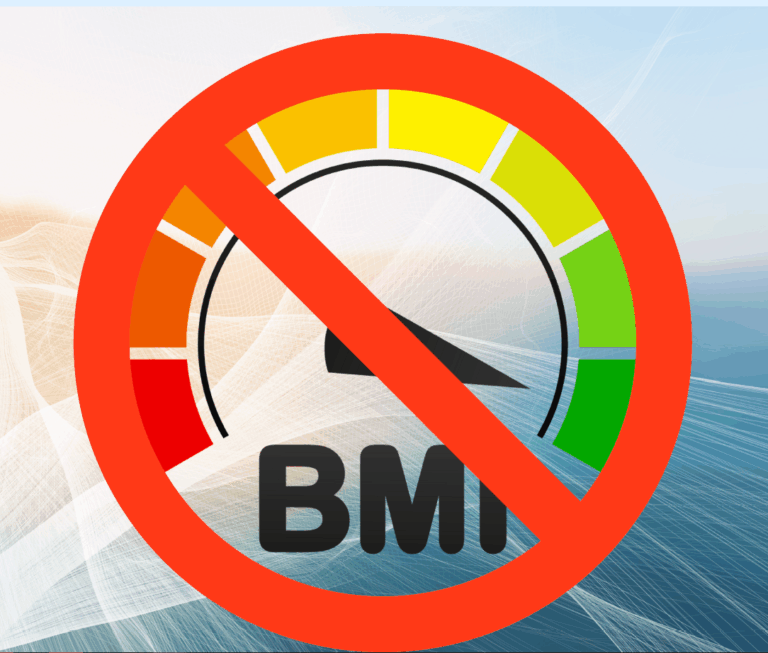
For decades, we’ve been told that a single number—the Body Mass Index, or BMI—defines our health. Doctors have charted it, employers have judged it, and insurance companies have used it as a measuring stick for everything from risk to reward. But here’s the truth most people won’t say out loud: the BMI is not science—it’s a shortcut. And it’s one that has done more harm than good.
The BMI was never meant to diagnose health. It was created nearly 200 years ago by a Belgian mathematician, not a physician, as a statistical tool to study populations—not individuals. Yet somehow, this outdated equation (weight divided by height squared) became the global standard for determining whether you’re “underweight,” “normal,” “overweight,” or “obese.” Think about that. A formula from the 1830s, created before modern medicine even existed, is still dictating how people see themselves and how the medical system treats them.
Let’s call it what it is: lazy medicine and institutional convenience.
Because here’s what BMI doesn’t tell you—it doesn’t measure muscle mass, bone density, body composition, metabolic health, or mental well-being. It doesn’t account for gender differences, age, or ethnicity. It doesn’t show whether your arteries are clear, your blood pressure is stable, or your body is inflamed from chronic stress. It just gives you a number. And in the process, it’s reduced countless human beings into a category that carries stigma, shame, and, too often, dismissal.
I’ve seen it firsthand. People labeled as “obese” who have strong hearts, balanced blood sugar, and the endurance to climb a mountain. And others with “ideal” BMIs who can barely climb a flight of stairs without their blood pressure spiking. The body cannot be reduced to a single metric—it is far too intelligent, far too complex, and far too individual.
Health is not a size. It’s a system.
True health is an integration of the physical, emotional, and energetic bodies. It’s how well your systems communicate—your heart with your brain, your gut with your immune system, your breath with your nervous system. It’s how your body adapts to stress, how it repairs after injury, and how it maintains balance even in chaos.
That’s why holistic health matters. It refuses to separate the parts of you that mainstream medicine has compartmentalized. It recognizes that your weight may fluctuate, your metabolism may slow, your hormones may change—but your worth and your wellness are not up for debate.
The tragedy of BMI-based thinking is that it’s not just inaccurate—it’s destructive. It creates fear where understanding should be. It teaches people to chase a number instead of listening to their bodies. And it has allowed an entire system to overlook the deeper markers that truly predict disease: inflammation, stress, blood pressure, insulin resistance, and lifestyle imbalance.
At the Bermuda Heart Foundation and CORE Heart Health Center, we see it every day. Patients walk in, defeated by the label they’ve been given—“overweight,” “at risk,” “non-compliant.” But when we look deeper, the truth tells a very different story. We focus on function, not figure. On movement, not measurement. On prevention, not punishment.
A “healthy” body is not a uniform ideal—it’s a living process. One that thrives on oxygen, hydration, nutrition, strength, purpose, and rest. When you feed the body with self-respect and movement, when you nourish the mind with compassion and curiosity, the body recalibrates. That’s biology and energy working in harmony—not a mathematical equation.
So why does BMI persist? Because it’s easy. It’s quick. And it fits neatly into a system built on statistics, not souls. But the world is changing, and medicine must change with it. We’re learning that metabolic health—not weight—is the true predictor of longevity. We’re learning that stress hormones can do more damage to the heart than a few extra pounds. And we’re finally acknowledging that health equity requires understanding the cultural, social, and emotional context behind everybody.
Your body is not a problem to be solved—it’s a partner to be understood.
If you want to know your real health status, start by asking different questions:
How well do I sleep?
Do I move my body with consistency and purpose?
What are my energy levels like throughout the day?
Do I eat foods that nourish me or numb me?
How quickly do I recover from stress, exercise, or illness?
Those answers will tell you far more than a BMI chart ever could.
The next time someone tries to define your health by a number, remember: the BMI doesn’t know your story. It doesn’t know your habits, your resilience, your recovery, or your fight. It doesn’t measure your courage to keep showing up when life hits hard.
You are not a data point—you are a whole, dynamic, living system.
And when you need a little help getting back on track, remember that the Bermuda Heart Foundation and CORE Heart Health Center have been guiding individuals, families, and companies toward stronger hearts and healthier lives for over 30 years.
Your path to wellness must be measured not in pounds or percentages, but in presence, persistence, and prevention. That’s where true health begins—and where the BMI illusion finally collapses under its own antiquated, misleading, harmful, overbearing weight.
Written by:
Simone J. Barton
CEO/Founder
Bermuda Heart Foundation
CORE Heart Health Center
